
Global Sales Activation
Single Item Pricing Promotion
Role
- Learning Experience Design
Company
- 1-800-GOT-JUNK?
Stakeholder
- Franchise Community
Deliverables
- eLearning Module
Overview
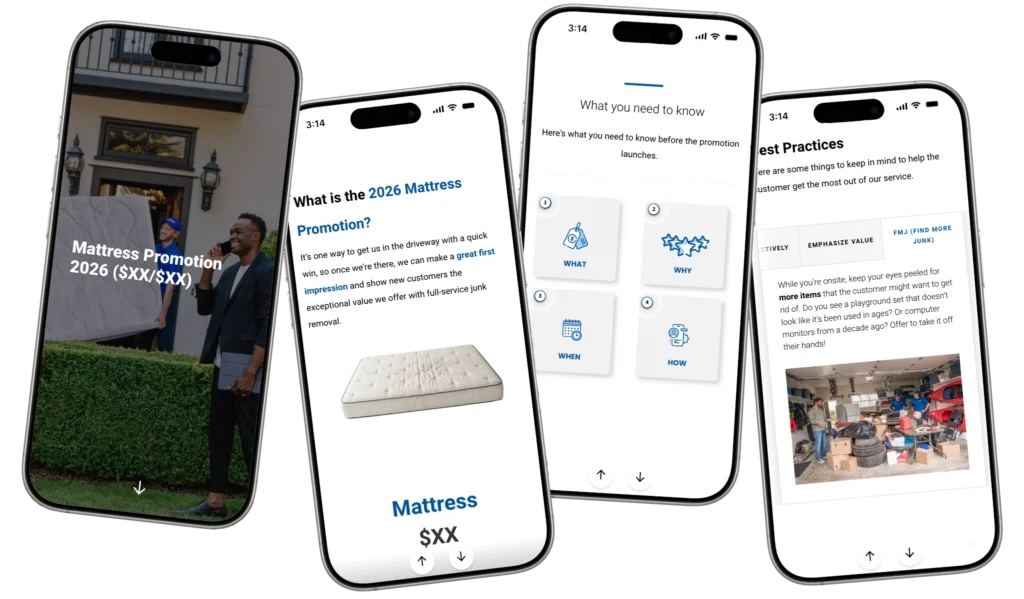
A high-stakes global sales promotion succeeds only if frontline teams understand the “Why” and the “How” from day one. With participating locations across the US, Canada, and Australia, we needed to align Truck Team Members and franchise management on a complex, localized pricing structure.
Problem
Despite the promotion being on the marketing roadmap for months, Learning & Development was brought in just two weeks before launch. We faced a perfect storm of constraints: three distinct pricing models with varying contexts and regional terminology differences. Furthermore, because individual ownership groups could opt in or out of the promotion, the LMS administration required precise audience segmentation.
Solution
Acting as the sole Instructional Designer, I partnered directly with the Marketing and Advertising departments to design, develop, and deploy three localized eLearning modules. By leveraging rapid authoring in Articulate 360 and utilizing ElevenLabs for region-specific AI voiceovers, I delivered hyper-relevant, targeted training on an accelerated timeline.
Impact
Achieved zero-error content assignment, ensuring only opted-in franchise groups received the training.
Course completion across participating locations.
Successfully delivered localized modules to our participating franchise locations.
Here's how I got there
Discovery
When I was brought onto the project two weeks before go-live, my first step was a rapid needs analysis. Marketing already had the promotional strategy mapped out, but that vision needed to be translated into actionable behaviors for the truck teams and franchise managers.
It quickly became apparent that a “one-size-fits-all” training module would fail. To avoid assigning teams irrelevant, US-centric content that would immediately degrade their buy-in and trust in our training, I had to define exactly what was needed:
Pricing
Each country had a distinct pricing tier and currency.
Terminology
Sales vocabulary varied depending on the location.
Distribution
Not every franchise was participating.
Motivation
Answer the question "What's In It For Me?".
The Build
I began by designing a single module that acted as the base template for the entire project.
Once the universal knowledge and behaviors that remained identical across all participating locations were created, I could leave placeholders for the variables. This shared information included:
The Parameters: Specific promotion dates and exactly which items were eligible for pickup.
System Procedures: Step-by-step instructions on how to properly enter the promotional code to apply the discount prior to payment processing.
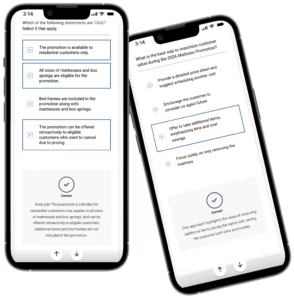
The Upsell Strategy: Soft-skills training on how to encourage customers to include additional items in their pickup, effectively increasing the overall value of every booked appointment.
Once approved, I then duplicated the original file and started on the region-specific data.
I swapped the placeholders for the regional pricing tiers and the correct currency labels. That way, when a Truck Team Member ran through a scenario, the information perfectly matched the reality of their local market, preventing any issues with customers.
I also reached out directly to our Australian franchise partners to validate the content needed for their teams. The use of “Mattress + Box Spring” wouldn’t make sense, since they would be collecting a “Mattress + Bed Base.” Additionally, the promotion was tied to different seasonal events. Pushing a “Spring Cleaning” narrative to a region entering Autumn creates an immediate disconnect.
Tools
I authored the interactive modules in Articulate 360 and designed custom UI elements via Adobe Creative Cloud. Using Eleven Labs, I replaced static customer scripts with dynamic, scenario-based storytelling. To meet tight deadlines, I leveraged AI to accelerate storyboarding, allowing for rapid iteration without sacrificing the quality of the final build.



Ideate & Prototype
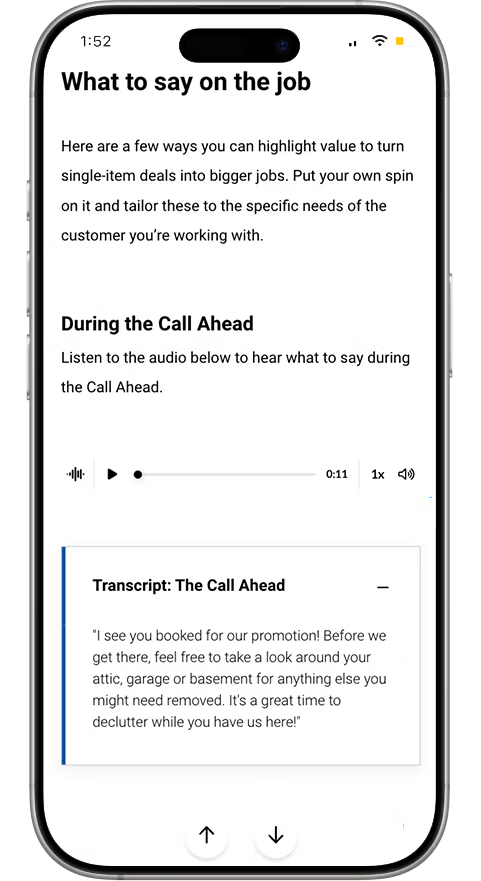
To help teams actually practice the upsell, I built out customer role-play scripts.
Here’s the catch: having an Australian truck team member listen to a North American voice actor immediately breaks immersion. It screams, “This training wasn’t actually made for you.” But casting and recording real voice actors for three different regions takes weeks, and I only had days.
To solve this, I utilized ElevenLabs, an AI audio platform that turns text into hyper-realistic, studio-quality voiceovers. For the Australian locations, I used natural, conversational Australian accents. This allowed me to provide a truly localized experience without having to record myself performing a bad Steve Irwin impression.
But cool AI voices don’t mean much if the course isn’t accessible. My personal rule when building in Articulate is that if there’s an audio block, I include a written transcript with it. That way, training is fully accessible for all learners, whether they need accommodations or are just trying to complete the module in a loud, busy warehouse.
Final Design
At the end of the day, these modules proved that rapid development doesn’t have to compromise the learner experience. By stripping away the corporate jargon and focusing strictly on the “What’s In It For Me,” we gave the truck teams a hyper-localized tool they could actually use to drive sales, not just another compliance box to check. We hit the deadline, avoided LMS chaos, and, most importantly, delivered training that respected frontline staff’s time.
Takeaways
We saw encouraging signs immediately post-launch, but the real impact became clear through user behavior.
Three months post-launch, we monitored a consistent upward trend in scores. Furthermore, the 2% increase in optional shop orders proved that the new design fostered real adoption and changed the culture around the program.
Lessons Learned
We pulled off the two-week turnaround, but it highlighted a much bigger process issue. I used the success of this project to advocate for earlier L&D integration with the Marketing and Advertising teams. Shifting from a reactive “order-taker” to a proactive partner means fewer fires to put out.
Using ElevenLabs allowed me to produce a high-production-value, localized multimedia experience without needing a massive budget or weeks of development time.
If a module doesn’t immediately answer the “What’s In It For Me?” for a busy Truck Team Member, it’s just corporate noise. Grounding the training in their daily reality (and making sure they didn’t have to sift through irrelevant pricing or listen to out-of-region accents) was the difference between forced compliance and actual buy-in.